As Need, As Want
On writing as a predilection

The first time I saw a moon as wounded as a pomegranate sliced open, blood sprouting through crystalline lattice onto the peel and trickling down my palm, was in Pipariya. I held coarse sand in my throat, a texture that refused to be erased despite countless gulps of Frooti, the sweetness of the juice rubbing against muscles, each swallow like a wheel skidding in the grey tar of a road struck alight. My jeans had frayed, dirt had created a strange effect of splotchy fading over the denim, my shoes were to be discarded upon return. I sat on a bench made of a graphite slab propped against a pillar, my back rested on the structure supporting the metal roof of the railway platform. I looked at the moon and thought of all the ways I could describe it. Each seemed unforgivingly boring. I had spent the past week trying to answer a difficult question poised by many strangers when they were informed of my dreams and aspirations, and it had left me depleted and doubtful. I had come to see cave paintings around Pachmarhi, marks and symbols that fed my ashamedly orientalist imagination of holding a talismanic power, surface inscriptions a mere contact with which would weave me into the flow of ancient time. I declared that I would write about this, whether as a visitation or an encounter or a meeting. The coolness of the caves embracing my parched skin, the sight of forgotten hills named after Spanish queens, the frail bodies of scavengers and hunters painted on the rocks, losing a shoe while scaling a cliff, was all material for a riveting story. But as I sat waiting on the platform, in a town I would only know from the inside of a moving vehicle, coursing through uncertain roads, past concrete forms rendered indistinguishable by speed and exhaustion, to reach the railway station for a train on which my booth was yet to be confirmed, I knew this much: I wouldn’t write about the caves. I wouldn’t even write about the moon that grew warmer with each automated announcement of the train’s delay, the safe and familiar shoulders of the tune that precedes railway updates in platforms across the country offering no respite. I had found something not comfortingly far in the order of time, but punishingly close and haunting: an unanswerable question.
“But why do you want to write?”
This question has always rung loud in my ears, even when it hasn’t been uttered. It seems to be a question I keep asking myself—why do I want to do this? Why this form of self-aggrandisement? Why this medium of work and leisure? I never had the assuredness to claim that I had stories to tell, so the early answers used to be, “I love to read, so now I want to write”. Then it changed to something along the lines of “oh well, I am studying and writing is a big part of that”. And then it became the more acceptable refrain, “I just can’t imagine doing anything else”. In these statements there is a spectrum of self-ridicule (I am reminded of Miroslav Holub’s Brief reflection on accuracy) and dishonesty—the final being the most dishonest, because of course, I can do other things, I have done them and will continue to do them. I suppose the more interesting questions would have been: “Where do you write from or what has writing done to you?”, but no one asked these. I didn’t even ask them to myself. I was too busy grappling with life, with the accumulation of days into weeks, hours into tasks: repetitive, dreary, dismal. And I was fascinated with the arrivals and flights of writing: to me and those around me.
I have seen writing become an ailment, an affliction that percolates from the psyche to the soma, that leaves a trail of bodily devastation as sleep is refused or ravished in an uncontainable pursuit; I have seen writing become a medicine, a corrective ingested to cure, transform, rid the mind and body of its excesses; I have seen writing as an outlet, an inroad, as circuitous routes that evade and ignore the boundaries of skin and flesh and dive into the tributaries of veins and blood; I have seen writing as a miracle, a moment of redemption, a catharsis in ink and stain; I have seen writing as a ripe apple filled with promise, a neon orange life jacket, a choreographed cardiopulmonary resuscitation, a glass bottle of masala soda passed between lips bearing traces of momentary togetherness, as the half-smoked cigarettes that Sahir discarded and Amrita finished, as the solar goblets of Kamala Das’s Summer in Calcutta. I have seen writing as a swift movement of the other’s eyes that recognise and bring you into presence from a flotsam of cloudy ether. And then, I have seen writing not be at all; dancing in delirium beyond the reach of my arms.
Many years before Pipariya, I sat on a cold metal bench in a hospital corridor in Hyderabad, still and unmoving after a few minutes of complete collapse as I wailed in a way that I haven’t before then or yet again. I had been informed that after a failed attempt to use a ventilator, my father had died in surgery. I remember thinking what to say to my sister, who needed to be called and informed of this. I didn’t have words then, and not in the way of how to utter the unspeakable and thus bring it to the position of fact, but as a general failure of vocabulary to be able to give legibility to sounds that hold a feral unknowability. What do I know of grief after having it wrung upon me? Nothing at all. All I know is that the precision of this memory, which I held on as a memento, doesn’t bring the comfort it used to. Am I sure the hospital floors were green stone or were they grey? The sun was strong, but what do I care if the sky was the colour of a bucket that has been left uncleaned for years, or if it was flushed like a freshly sliced papaya? Who cares for beauty, for accuracy, for memory as a mirror in the face of eviscerating brute luck? And yet, the only way to begin to make sense of this has been to write. It is a skeptical call for possession, a reverse-exorcism, a grudging acceptance that there are only so many roads out of pain, and unfortunately writing isn’t one of them; but it is a map to the misty waters of figuring, the delicate balance between unconcealment and non-truths.
Sometimes I want to use small words
and make them important
and it starts shouting the dictionary,
the opportunities.
From That Little Beast, Mary Oliver
I want to dwell on detail a bit, because it is such a central part of all kinds of writing—the piercing needle of an observation or the slightest attentive hook that produces trust in sharp objects tearing through the veil of dailyness, that makes you believe in the genius of the writer, their wisdom and unique faculties that can discern things beyond or below ordinary perception—that they have swum through the tides to find a safe haven in the perfect arrangement of words, and you the discerning reader have felt and thought and responded to such brilliance. But safety is the last thing writing has given me. It is not an asylum from the ravages of life. It has always felt like holding a tattered blanket, the raincoat with holes, an upturned umbrella as you walk into a thunderstorm. The detail in writing as an expression of fraternity has strained to hold the weight of authenticity in a life spent finishing up—magical occurrences circle the drain and depart unnoticeably.
A rat indigo with rain
races under the banyan tree.
You point it out,
prise stones from soil,
lift up your sleeve,
Make me see the bruise
blackish, saffron edged
where you hurt yourself.
Touching you I think:
we pay with our lives
they become us.
And I need to write
as if penitence were
the province of poems
From Red Parapet, Meena Alexander
When I started work on my M.Phil thesis, the only thesis I think I will ever write, it was an endeavour of promise. My father nursed a slight cough but read the drafts of the proposal, spoke with me about thinkers and ideas, suggested books, debated and disagreed, argued with me occasionally. Over the course of a year, as the draft grew, so did his cough, and by the end of it, I had gained a research proposal but had lost my father. I remember deciding in that moment that of course, I would not finish the thesis, it made no sense at all. But I returned to the city and realised I needed shelter, I needed the stipend, I needed the fellowship, I needed money and a roof and so I stayed enrolled and wrote the lengthiest document I would ever write. It makes no claims to any rigour of thought or methodology. It is however, a testament to many other things: the absence of those who shaped it, the kindness of teachers who assumed a protective guardianship, those who opened their doors and emptied their time for me, my own life and its exceptional miseries, its persistent joys, its peculiar tragedies that bind and release me, that are deprivations but also sources of strange connections in this world filled with people who have lost, repeatedly. This year I read about Jesmyn Ward’s devastating loss in the midst of an uprising against recurring injustices borne by communities who have repeatedly risen for freedom, and wept because the worlds held in the palm of her words felt familiar. Despite impenetrable distances and inconsolable locations, her words entered and sat within me.
Perhaps the closest I could arrive at describing the why and where of writing would be this: I have written to survive. To survive onslaughts and deprivations, to survive the loss of others and myself. To survive, so I could wail again the way I did, to breathe through anguish, and to laugh again with abandon. Writing doesn’t give me any of this, but it watches things unfold, sometimes by my side, sometimes near enough to wink but too far for any real warmth. It stays, it leaves, it returns, often it sits between waste waiting to be sorted into responsible piles of that which withers to nothingness and that which must be repurposed. Now, when I think of being asked “Why write?”, I would just say, “why not?”
*
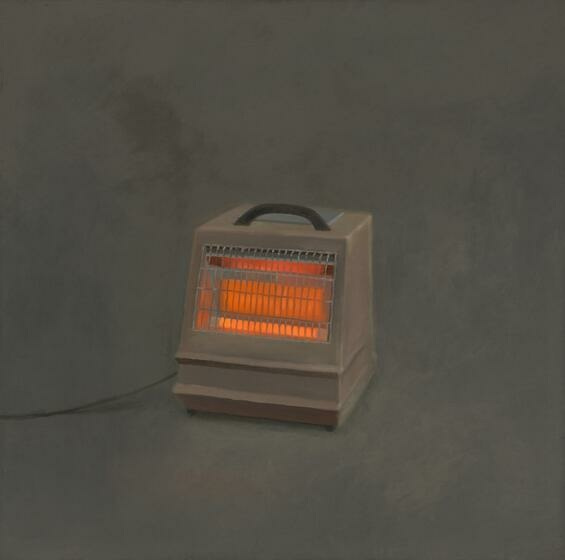
Image: Vija Celmins, Heater, 1964.
Tata-bye-bye to this year, and may this “more letter, less news” find its way to you in the next.
Your writing is beautiful and moving, Arushi. Thank you for sharing something so painful. I hope this year is being kinder. - Kriti